Building a Vermont Clinical Plan for South Alabama
Vermont is a full practice state, with a transition-to-practice requirement for qualifying new APRNs before independent practice. South Alabama students locate their own sites and preceptors, with Office for Clinical Affairs assistance and approval.
Tell us your USA track and city. No payment until your preceptor and site are confirmed.
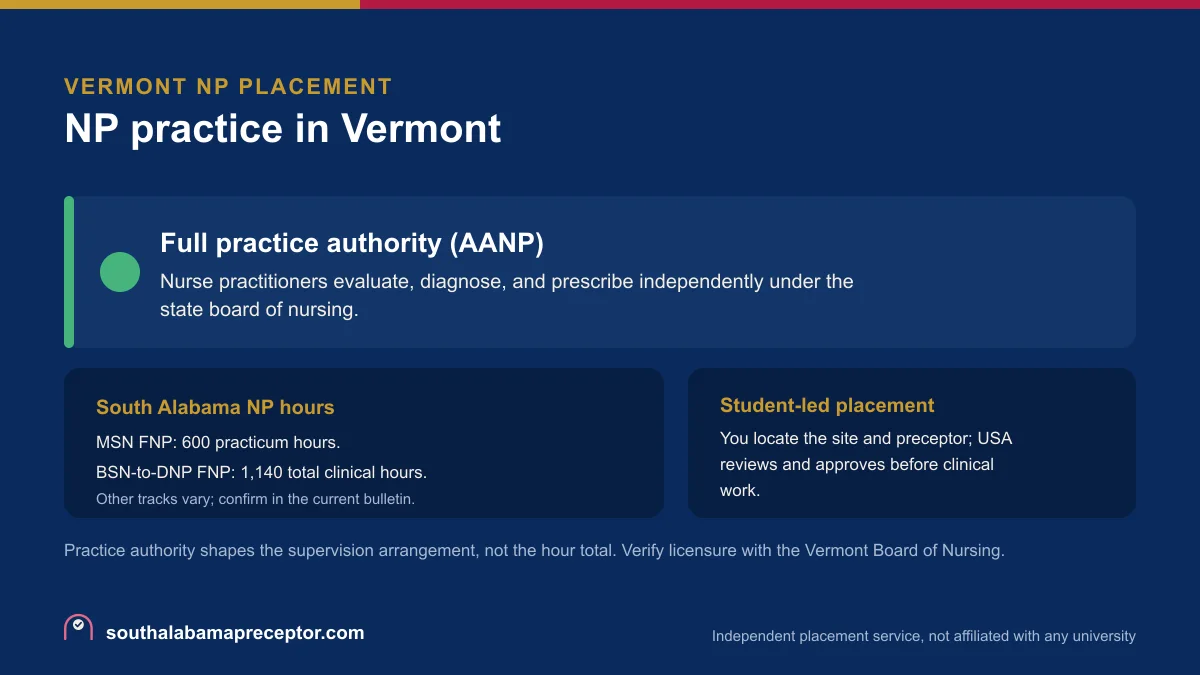
Full practice follows Vermont's transition framework
AANP categorizes Vermont as a full practice state. Nurse practitioners who meet state licensure and transition requirements may evaluate, diagnose, treat, and prescribe without a permanent physician collaboration agreement. Qualifying newer APRNs complete the transition process.
Verify whether the proposed clinician has completed any applicable transition requirement and is practicing under current authority. Full practice does not establish South Alabama course fit or student scope.
The preceptor should be licensed in the relevant specialty, approved by South Alabama, and experienced for at least one year. Students remain supervised.
Confirm credentials with the Vermont Board
The Vermont Board of Nursing, within the Office of Professional Regulation, licenses nurses and APRNs and publishes rules and verification. Check the candidate's active credential, population focus, transition status when relevant, and public record.
Request a current CV and ask about patient ages, diagnoses, volume, available days, student history, and direct supervision. Confirm that the patient panel supports the course.
Identify the authorized site contact. A health system may centralize educational review, while a small clinic may decide locally. Both need authority to complete documents and onboarding.
Plan a regional Vermont search
Burlington has the state's largest concentration of primary, psychiatric, adult, women's health, and specialty care. Montpelier and Barre form a central cluster, while Rutland serves a broad south central region.
Brattleboro and Bennington are southern anchors. St. Johnsbury can support a Northeast Kingdom search. Smaller towns may offer broad patient exposure but limited student capacity, making early outreach useful.
Weather and early shifts affect the practical commute. A site in New York, New Hampshire, or Massachusetts requires separate South Alabama location review.
A rural practice may offer broad care and continuity, but verify qualifying patient volume across the entire term. Ask about coverage during weather closures, clinician leave, and lower-volume weeks. Keep the exact address, proposed schedule, specialty, patient ages, weekly capacity, and authorized organizational contact together. Those details help the Office for Clinical Affairs evaluate whether a site is workable and whether a second setting may be needed before the course begins.
Use South Alabama's student-led process
Students locate their own sites and preceptors in their home region. The Office for Clinical Affairs assists with placement tasks, and South Alabama reviews and approves the Vermont clinician and organization before clinical activity.
Placement is tied to full admission. Confirm current status, timing, course rules, and submission documents before seeking a commitment. A verbal yes does not complete approval.
The organization may require health documentation, background review, privacy education, learner applications, or orientation. Allow time for agreement and compliance work.
Match the Vermont site to program hours
The MSN FNP requires 600 hours across CMN 573, CMN 575, and CMN 576, divided into 180, 180, and 240 hours. The BSN-to-DNP FNP totals 1,140 hours, including 600 practicum and 540 residency hours.
The dual FNP and Emergency NP MSN requires 840 clinical hours. Other tracks vary. Confirm the current handbook, sequence, eligible settings, and patient requirements before assigning expected hours.
A Vermont practice may support only part of the plan. Ask about continuity, volume, specialty exposure, and schedule stability, and begin another search when needed.
Plan online study and Mobile orientation
Coursework is online, and clinical experiences generally occur in the student's home region. NP DNP students attend a Mobile orientation typically lasting about three to five days. Confirm current format and dates.
Online delivery does not prove Vermont program or placement authorization. Confirm current South Alabama availability for the actual site and patient locations before sourcing.
We source physical placements and virtual preceptorship routes. Virtual care depends on the course, university, site, state, patient location, and preceptor setup. Confirm accepted activity before relying on it.
Review the match before payment
Students see the match before payment and pay only when a placement is secured. The fee covers sourcing, verification, and compliance coordination. Pricing appears on the cost page. South Alabama and the site retain approval authority.
Provide the track, course, term, Vermont region, travel limits, schedule, patient needs, and virtual preference for accurate screening.
Send them through a free placement review. We will compare physical and virtual routes without treating this page as proof of state eligibility.
Use Vermont continuity without overestimating capacity
A Vermont community practice may expose a student to continuity across ages and conditions, but a small clinician roster can leave little room for schedule changes. Ask about provider leave, seasonal volume, outreach locations, student limits, and who can supervise when the primary preceptor is unavailable. Confirm that the patient population meets the course instead of assuming a broad rural panel covers every objective.
Burlington and Chittenden County offer the deepest market, while Montpelier, Barre, Rutland, Brattleboro, and St. Johnsbury can support a regional search. Winter travel and long cross-state routes need a conservative plan. An adjacent-state or virtual option must be evaluated by its actual site, patient locations, licenses, supervision, and South Alabama requirements rather than by the student's home address alone.
Good to know
Is Vermont a full practice state?
Yes. AANP categorizes Vermont as full practice, with a transition requirement for qualifying new APRNs.
Does South Alabama assign Vermont preceptors?
Students locate sites and preceptors. The Office for Clinical Affairs assists, and South Alabama reviews and approves them.
How many hours does the BSN-to-DNP FNP require?
It totals 1,140 hours, including 600 practicum and 540 residency hours.
Does this page prove Vermont eligibility?
No. Confirm current South Alabama program and clinical availability for the actual site before sourcing.
Clear the gate, not your calendar
Tell us your track, your city, and your admission timeline. We will come back with a placement plan and a realistic path to full admission and your clinical hours.