How our University of South Alabama clinical placement works, step by step
Our placement process moves a University of South Alabama nurse practitioner student from a conditional seat to full admission by doing the four things USA holds the student responsible for: sourcing a qualified preceptor and site, verifying they meet USA eligibility rules, completing Castle Branch compliance, and getting the placement logged in CAPS through the Office for Clinical Affairs. Below is exactly what happens, in order, and where your money goes.
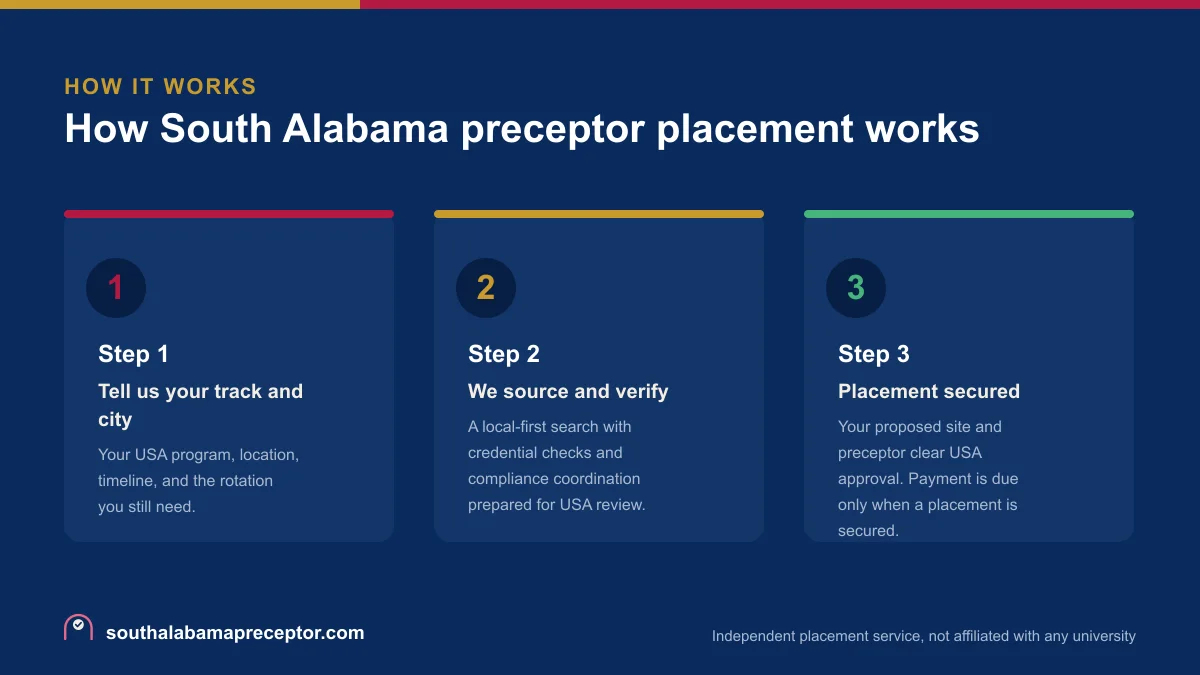
Tell us your USA track and city. No payment until your preceptor and site are confirmed.
What does USA actually require me to do myself?
USA requires you to locate your own clinical site and preceptor, because it runs a student-led placement model and gives no guarantee of approved placement. The College of Nursing's Office for Clinical Affairs assists as needed, but the burden of finding an approved preceptor sits with you.
This matters because placement is an admission gate. You must identify a clinical placement to earn full admission. Without one, you are admitted only conditionally and capped to a limited number of support credit hours, and if a placement still cannot be secured, the remedy USA offers is to transfer your earned credits to another school. Our whole service exists to close that gap for you before it delays your program.
Post-graduate APRN certificate students face an even firmer bar: you must prove a guaranteed preceptor and site to receive full admission, not merely name a prospect.
Step one: how do you source a USA-approved preceptor and site?
We source a preceptor who is licensed in your specialty, USA-approved, and holds at least one year of experience, matched to your track and your home region. USA students complete clinicals in their home region while coursework stays fully online, so we build the search around where you live rather than around Mobile.
We reach out to practices and providers directly, confirm they are willing to precept for your specific NP track (for example FNP, PMHNP, or AG-ACNP), and confirm the site can host the rotation. Precepting is a professional service to the profession, so nothing we do involves paying a preceptor; our fee never becomes a payment to a preceptor.
Because different USA tracks carry different practicum structures, we align the site to the courses you will actually take, so the hours you complete count toward your program rather than sitting unused.
Step two: how do you verify the preceptor meets USA's rules?
We verify each preceptor against USA's three eligibility conditions before you commit: specialty licensure, USA approval, and a minimum of one year of experience. Skipping this check is the single most common reason a self-arranged placement gets rejected, so we do it up front.
Verification also covers the site itself, confirming it fits the clinical requirements of your track and the specific practicum course you are entering. For MSN FNP students, for instance, that means confirming the site supports the three practicum courses CMN 573, CMN 575, and CMN 576.
You pay only once the preceptor and the site are confirmed, so verification is complete before any placement fee is due.
Step three: how does Castle Branch compliance get completed?
We handle the Castle Branch (myCB) compliance workload so nothing stalls your start date. Castle Branch is USA's compliance vendor and includes a Medical Document Manager, a background check, and an 11-panel drug screen.
On the health side, myCB tracks your required immunizations, which include MMR, Varicella, Hepatitis B, and TDAP. We organize the document uploads, flag what is missing, and keep the file moving so your compliance record is complete and current when the placement is submitted.
This is legwork our fee is designed to cover: sourcing, USA-eligibility verification, and the Castle Branch and CAPS work, all bundled into one service rather than left for you to chase between coursework.
Step four: how does the placement get logged in CAPS?
We get your confirmed, compliant placement logged in CAPS, USA's in-house clinical placement and tracking system run by the Office for Clinical Affairs. CAPS is where USA records and tracks approved placements, so a placement that is not in CAPS is not yet recognized.
Once the preceptor and site are verified and Castle Branch compliance is complete, the placement can be entered and tracked in CAPS, which is what moves you from conditional to full admission. This final step is the reason the whole process is worth doing correctly rather than piecemeal.
For NP DNP tracks, remember you will still report to Mobile, Alabama for roughly three to five days of orientation; the CAPS-logged clinical placement is separate from that on-campus orientation window.
What does this service cost and when do I pay?
Independent NP preceptor placement runs roughly 1,500 to 2,500 dollars per rotation across the market, with psychiatric and acute-care rotations at the higher end. You pay only once the preceptor and site are confirmed, never before.
Our fee covers sourcing the preceptor, verifying USA eligibility, and completing the Castle Branch and CAPS legwork. It is never a payment to the preceptor; the fee reflects our sourcing and coordination work.
We simply do the placement work USA holds you responsible for, so you can reach full admission on schedule.
Good to know
Does USA guarantee my clinical placement?
No. USA runs a student-led model and gives no guarantee of approved placement. Students must locate their own site and preceptor, with the Office for Clinical Affairs assisting as needed. Our service exists to do that sourcing and verification for you.
What happens if I cannot find a placement on my own?
Without a placement you are admitted only conditionally and capped to a limited number of support credit hours. If a placement still cannot be secured, USA's remedy is to let you transfer your earned credits to another school. Securing a placement is how you avoid that outcome.
What is CAPS and why does it matter?
CAPS is USA's in-house clinical placement and tracking system, run by the Office for Clinical Affairs. A placement is only recognized once it is logged and tracked in CAPS, so getting your confirmed placement into CAPS is the step that supports full admission.
What does Castle Branch compliance include?
Castle Branch (myCB) is USA's compliance vendor. It includes a Medical Document Manager, a background check, and an 11-panel drug screen, plus tracking of required immunizations such as MMR, Varicella, Hepatitis B, and TDAP.
Are you affiliated with the University of South Alabama?
No. We handle the sourcing, verification, Castle Branch compliance, and CAPS logging that USA holds the student responsible for.
From conditional admission to full admission
| Step | What happens |
|---|---|
| 1. Source | USA-approved preceptor and site in your home region |
| 2. Verify | Specialty licensure, USA approval, minimum one year of experience |
| 3. Comply | Castle Branch: Medical Document Manager, background check, 11-panel drug screen |
| 4. Log in CAPS | Placement recorded via the Office for Clinical Affairs; conditional becomes full admission |
Sources: USA College of Nursing, Clinical Placement; USA Office for Clinical Affairs; USA College of Nursing, Online MSN; USA College of Nursing Accreditation.
Clear the gate, not your calendar
Tell us your track, your city, and your admission timeline. We will come back with a placement plan and a realistic path to full admission and your clinical hours.