The University of South Alabama clinical placement policy, explained
The University of South Alabama's clinical placement policy is student-led: USA gives no guarantee of approved placement, requires students to locate their own clinical site and preceptor, and treats securing that placement as an admission gate. Without a placement you are admitted only conditionally and capped to limited support credit hours, and if one cannot be secured the remedy USA offers is transferring your earned credits to another school. This guide explains each part of that policy so you know exactly what USA is promising and what it is not.
Tell us your USA track and city. No payment until your preceptor and site are confirmed.
Does USA guarantee I will get a clinical placement?
No, USA gives no guarantee of approved placement. The College of Nursing runs a student-led model in which you are responsible for locating your own clinical site and preceptor, with the Office for Clinical Affairs assisting as needed rather than placing you.
This is the foundation of the entire policy. Every other rule below (the admission gate, the conditional cap, the transfer-out remedy) follows from the fact that the placement is your responsibility to secure, not the university's to provide.
Understanding this early is what separates students who plan ahead from those who stall, because the university will not backfill a missing placement for you.
Why is clinical placement an admission gate?
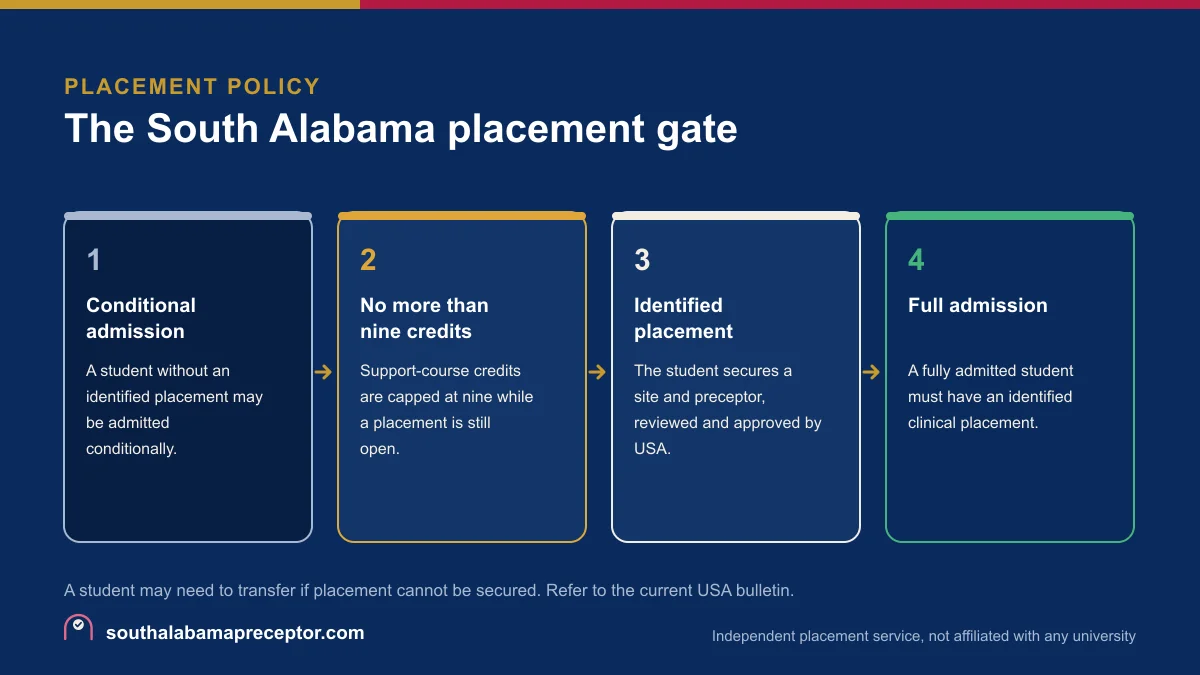
Placement is an admission gate because USA requires you to identify a clinical placement to earn full admission. It is not a task you can defer until later in the program; it is a condition of being fully admitted.
Practically, this means your placement search should begin before or alongside enrollment, not after coursework starts. The gate is designed so that students who cannot secure clinical training do not advance deep into a program they cannot finish.
Our service is built specifically to clear this gate: we source and verify a USA-approved preceptor and site so the admission requirement is met on time.
What happens if I am only conditionally admitted?
If you cannot yet identify a placement, USA admits you only conditionally and caps you to a limited number of support credit hours. You can begin some coursework, but you cannot progress freely without a placement in place.
This cap is the university's guardrail. It lets you start while protecting you from accumulating a full program's worth of credits with no path to the required clinical training. The way out of the cap is to secure and log an approved placement.
Because the cap limits how far you can go, treating placement as urgent from day one is the practical reading of this policy.
What is the remedy if a placement cannot be secured?
If a placement genuinely cannot be secured, the remedy USA offers is to transfer your earned credits to another school. That is the university's stated fallback, and it is an honest signal of how firmly the placement requirement is enforced.
This remedy is not a punishment; it is a recognition that a program requiring clinical training cannot be completed without a clinical placement. Still, transferring out is a setback most students would rather avoid, which is the strongest argument for securing a placement early.
Our sourcing and verification work is aimed at making that transfer-out remedy unnecessary for you.
How does the policy differ for post-graduate APRN certificate students?
Post-graduate APRN certificate students face the strictest version of the policy: you must prove a guaranteed preceptor and site to receive full admission, not merely name a prospect or express intent.
This higher bar reflects that certificate students are already licensed professionals adding a specialty, so USA expects the clinical arrangement to be firm before it fully admits you. A tentative lead is not enough at this level.
For certificate applicants, that means the sourcing, USA-eligibility verification, and confirmation of the preceptor and site need to be locked before you apply for full admission, which is exactly the work our service performs.
Which programs and accreditors does this policy cover?
This placement policy applies across USA's CCNE-accredited nursing programs, including the master's, DNP, and post-graduate APRN certificate, as well as the CCNE-accredited NP Residency. These programs are accredited by CCNE, not ACEN, and USA's institutional accreditor is SACSCOC.
Regardless of program, an approved placement runs through the same machinery: a preceptor who is licensed in the specialty, USA-approved, and holds at least one year of experience; Castle Branch (myCB) compliance; and logging in CAPS by the Office for Clinical Affairs.
Coursework is fully online and clinicals are completed in your home region, though NP DNP tracks report to Mobile, Alabama for roughly three to five days of orientation.
Good to know
Is USA responsible for finding my clinical placement?
No. USA runs a student-led model and gives no guarantee of approved placement. You must locate your own site and preceptor, with the Office for Clinical Affairs assisting as needed.
Can I be fully admitted without a placement?
No. Placement is an admission gate. Without one you are admitted only conditionally and capped to a limited number of support credit hours until you secure and log an approved placement.
What does USA do if no placement can be found?
USA's stated remedy is to let you transfer your earned credits to another school. Securing an approved preceptor and site early is how students avoid that outcome.
Do post-graduate APRN certificate students have stricter rules?
Yes. Certificate students must prove a guaranteed preceptor and site to receive full admission, a higher bar than naming a prospect. The clinical arrangement must be firm before applying.
USA clinical placement policy at a glance
| Stage | USA rule |
|---|---|
| No guarantee | The school gives no guarantee of approved placement |
| Admission gate | A placement must be identified to earn full admission |
| Conditional cap | Capped to limited support credit hours until a placement is identified |
| Transfer-out remedy | Earned credits may transfer to another school if none can be secured |
| Certificate students | Must prove a guaranteed preceptor and site for full admission |
Sources: USA College of Nursing, Clinical Placement; USA Office for Clinical Affairs; USA College of Nursing, Online MSN.
Clear the gate, not your calendar
Tell us your track, your city, and your admission timeline. We will come back with a placement plan and a realistic path to full admission and your clinical hours.