USA DNP Preceptor and Residency Placement for BSN-to-DNP Students
If you are a University of South Alabama BSN-to-DNP Family Nurse Practitioner student, you must secure your own preceptors and clinical sites for both practicum and DNP residency before USA grants full admission, and we source, verify, and CAPS-log those placements for you. The BSN-to-DNP FNP totals 1,140 clinical hours: 600 practicum plus a 540-hour DNP residency, within a 69 credit hour program. USA's student-led model gives no guarantee of approved placement and assists only as needed through the Office for Clinical Affairs, so as an independent placement service we handle sourcing, Castle Branch compliance, and CAPS logging across the full doctoral arc.
Tell us your USA track and city. No payment until your preceptor and site are confirmed.
How many clinical hours does the USA BSN-to-DNP FNP require?
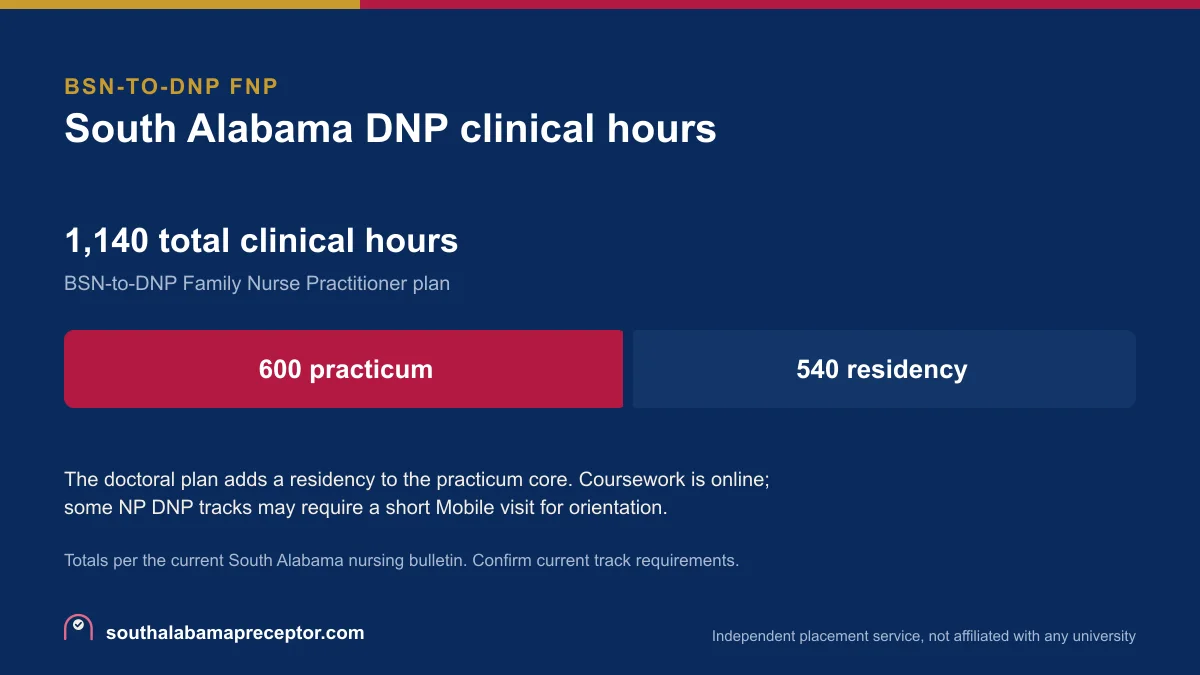
The USA BSN-to-DNP FNP requires 1,140 total clinical hours, made up of 600 practicum hours plus a 540-hour DNP residency, in a 69 credit hour program. The 600 practicum hours mirror the MSN FNP structure across three practicum courses, while the 540 residency hours are additional and tied to your DNP scholarly project work.
Because the doctoral path spans both practicum and residency, you may need multiple preceptors and sites over the program. We plan placement across the entire 1,140-hour arc so a gap in practicum or residency does not stall your progression toward the degree.
What is the difference between practicum and DNP residency placement?
The difference is purpose and stage: the 600 practicum hours build your FNP clinical competency, while the 540 DNP residency hours are doctoral-level and support the implementation and scholarly work of your DNP project. Both require a USA-approved preceptor and site logged in CAPS, but the residency often calls for a setting aligned to your project focus rather than a general FNP rotation.
We source both kinds of placement:
- Practicum: primary-care family and internal-medicine sites for the 600 FNP hours
- Residency: a site and preceptor that fit your DNP project scope for the 540 residency hours
Coordinating the two together, rather than scrambling for a residency site late, is what keeps a doctoral timeline intact.
How does the admission gate apply to DNP students?
The admission gate applies to DNP students the same way it applies across USA NP tracks: you must identify a clinical placement to receive full admission, and without one you are admitted only conditionally and capped to a limited number of support credit hours. If a placement cannot be secured, USA's remedy is transferring your earned credits to another school.
For a 69 credit hour doctoral program, that risk is significant, because you are committing to a long, expensive path that hinges on placement you must source yourself. If you are entering through a post-graduate APRN certificate, note that certificate students must prove a guaranteed preceptor and site for full admission, an even stricter bar. We work to lock in confirmed placements early so your doctoral standing is never in question.
Is the USA DNP and NP Residency accredited?
Yes. USA's DNP is accredited by CCNE, the Commission on Collegiate Nursing Education, which also accredits the baccalaureate, master's, and post-graduate APRN certificate programs, along with the CCNE-accredited NP Residency. USA is not ACEN-accredited, and the institution's regional accreditor is SACSCOC.
Accreditation matters for placement because a USA-approved preceptor and a properly logged CAPS placement keep your hours valid against these accredited program requirements. We verify preceptor eligibility, licensed in the specialty, USA-approved, and holding a minimum of one year of experience, against those standards before you commit.
What compliance and logistics apply to DNP placements?
Before any practicum or residency rotation, you must clear Castle Branch (myCB) compliance, which we complete as part of placement. Castle Branch includes a Medical Document Manager, a background check, and an 11-panel drug screen, with immunizations for MMR, Varicella, Hepatitis B, and TDAP.
On logistics, USA coursework is fully online and clinicals are completed in your home region, so we source both practicum and residency preceptors near you. NP DNP-track students report to Mobile, Alabama for about three to five days of orientation. Every confirmed placement across the 1,140 hours is logged in CAPS so it counts toward full admission and degree completion.
What does DNP preceptor and residency placement cost?
Independent NP preceptor placement runs roughly 1,500 to 2,500 dollars per rotation across the market. Because a BSN-to-DNP program spans multiple practicum rotations plus a 540-hour residency, doctoral students typically arrange several placements over the program rather than a single one. You pay only once each preceptor and site are confirmed.
What you are paying us for is the search itself: sourcing each preceptor, verifying USA eligibility, and carrying out the Castle Branch and CAPS legwork. None of that money goes to the preceptor; it pays for our sourcing and coordination effort.
Good to know
How many hours is the USA BSN-to-DNP FNP?
The BSN-to-DNP FNP totals 1,140 clinical hours: 600 practicum plus a 540-hour DNP residency, within a 69 credit hour program. Both practicum and residency placements must be USA-approved and logged in CAPS.
What is the difference between the practicum and the DNP residency?
The 600 practicum hours build FNP clinical competency in primary-care sites, while the 540 residency hours are doctoral-level and support your DNP scholarly project, often at a site aligned to your project focus. We source both.
Is the USA DNP accredited by CCNE?
Yes. CCNE accredits USA's DNP, along with the baccalaureate, master's, post-graduate APRN certificate, and the NP Residency. USA is not ACEN-accredited, and the institution's regional accreditor is SACSCOC.
Do DNP students have to visit campus?
Yes. Coursework is fully online and clinicals are completed in your home region, but NP DNP-track students report to Mobile, Alabama for about three to five days of orientation.
What is required if I enter through a post-graduate APRN certificate?
Post-graduate APRN certificate students must prove a guaranteed preceptor and site for full admission, a stricter bar than the general admission gate. We source and verify that guaranteed placement so you can secure full admission.
USA BSN-to-DNP FNP clinical hours at a glance
| Component | Clinical hours | Purpose |
|---|---|---|
| FNP practicum | 600 | Primary-care clinical competency |
| DNP residency | 540 | Doctoral scholarly project work |
| Total (69 credit hours) | 1,140 | Full BSN-to-DNP FNP path |
Sources: USA DNP Family Nurse Practitioner; USA College of Nursing Accreditation; USA College of Nursing, Clinical Placement; AACN Essentials.
Clear the gate, not your calendar
Tell us your track, your city, and your admission timeline. We will come back with a placement plan and a realistic path to full admission and your clinical hours.