What Does University of South Alabama Preceptor Placement Cost?
Independent NP preceptor placement for University of South Alabama students runs roughly 1,500 to 2,500 dollars per rotation across the market, and you pay only once a USA-approved preceptor and clinical site are confirmed. USA runs a student-led placement model, which means the school gives no guarantee of approved placement and expects you to locate your own preceptor and site with assistance from the Office for Clinical Affairs as needed. That gap is exactly what our fee closes. Below we break down the real number, when you pay, what the fee does and does not cover, and the harder math of what a missing placement actually costs you.
Tell us your USA track and city. No payment until your preceptor and site are confirmed.
How much does an NP preceptor placement service cost per rotation for USA students?
An independent NP preceptor placement service runs roughly 1,500 to 2,500 dollars per rotation across the market, with psychiatric and acute-care rotations sitting at the higher end. This is a market range, not a USA fee, and not a number we invented: it reflects what independent placement services charge nationally to source and verify a qualified preceptor for a single clinical practicum course.
Where a given rotation lands inside that 1,500 to 2,500 range depends mostly on specialty scarcity. Family NP (FNP) primary-care rotations tend to sit toward the lower end because eligible preceptors are more plentiful. Psychiatric Mental Health NP (PMHNP) and Adult-Gerontology Acute Care NP (AG-ACNP) rotations sit toward the higher end because licensed, USA-approved preceptors in those specialties are harder to find and harder to schedule.
One important framing: a USA MSN FNP requires 600 clinical practicum hours across three practicum courses (180 + 180 + 240, courses CMN 573, CMN 575, and CMN 576). Some students need a preceptor for each of those courses, and some can keep one preceptor across multiple courses. Your total cost is per rotation you actually need placed, not a flat lifetime fee, so confirm your course structure against your current USA handbook before you estimate a total.
When do I pay, and what if you cannot find a preceptor?
You pay only once the preceptor and clinical site are confirmed, never up front on a promise. Because USA gives no guarantee of approved placement and requires a real, USA-approved preceptor before you can log the site in CAPS, we hold billing until that match exists and is verifiable.
This structure protects you from the most common risk in the placement market: paying a deposit for a search that never produces a usable preceptor. If we cannot secure a USA-approved preceptor and site for your rotation, you are not charged our placement fee for that rotation. That keeps our incentives aligned with the only outcome that matters to your admission, which is a preceptor USA will actually approve.
A USA-approvable preceptor is not just any willing clinician. The preceptor must be licensed in the specialty, USA-approved, and hold a minimum of one year of experience. Part of what you are paying for is the verification work that confirms a candidate clears those bars before you commit.
What exactly does the fee cover?
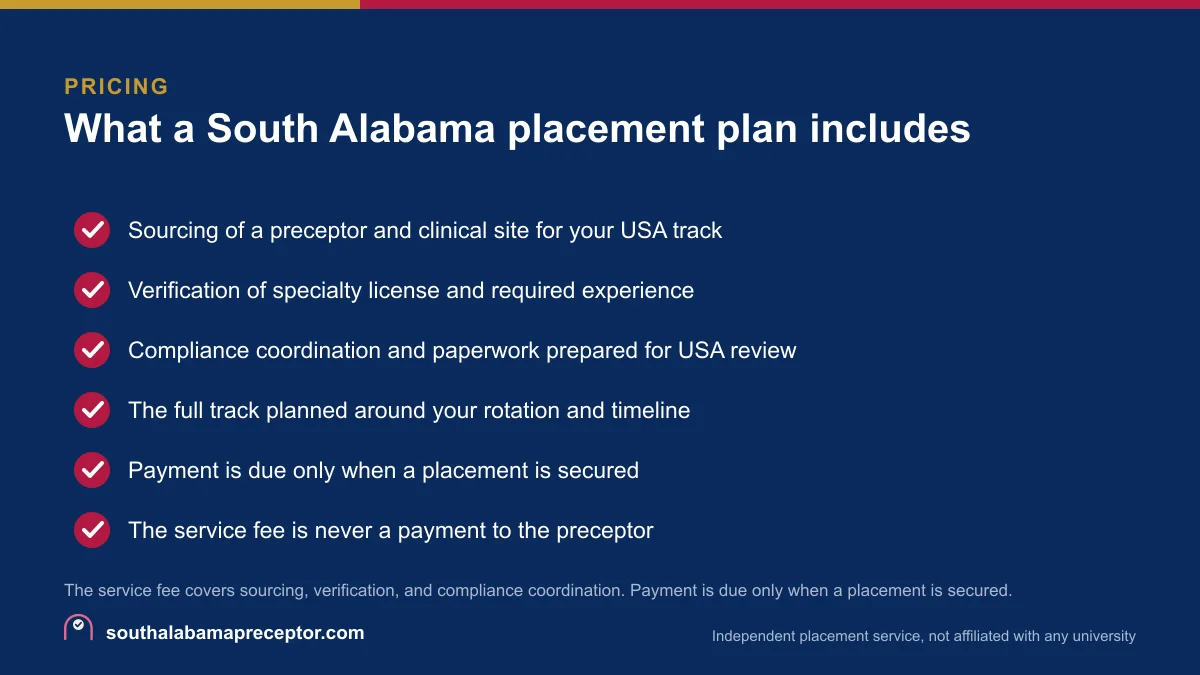
Your fee covers sourcing a USA-approved preceptor and site, USA-eligibility verification, and the Castle Branch and CAPS legwork that gets the placement logged so you can reach full admission. It does not cover, and never includes, a payment to the preceptor. Here is the concrete breakdown:
- Sourcing: We identify a candidate preceptor and clinical site in your home region, where USA expects clinicals to be completed.
- USA-eligibility verification: We confirm the preceptor is licensed in the specialty, USA-approved, and carries at least one year of experience, so the site is one USA will accept.
- Castle Branch (myCB) compliance: We help you complete the Medical Document Manager, the background check, and the 11-panel drug screen, and organize immunization records including MMR, Varicella, Hepatitis B, and TDAP.
- CAPS logging: We get the confirmed placement into CAPS, USA's in-house clinical placement and tracking system run by the Office for Clinical Affairs, which is the step that moves you toward full admission.
What the fee never pays for is the preceptor themselves. Precepting is a professional service to the profession, and our fee is for the sourcing and coordination work only: we do not pay preceptors, and we do not pass a payment to them through us.
Why is a missing preceptor so expensive beyond the placement fee?
The real cost of a missing preceptor is not the placement fee, it is the admission and credit consequences USA attaches to placement. At USA, placement is an admission gate. You must identify a clinical placement for full admission. Without one, you are admitted only conditionally and capped to a limited number of support credit hours.
That cap is the hidden math. Conditional admission does not let you progress freely: your enrollment is throttled until a placement exists. The longer a rotation goes unplaced, the longer you sit against that ceiling, unable to advance through your practicum courses on schedule.
The worst-case outcome is more severe than delay. If a placement cannot be secured, the remedy USA offers is to transfer your earned credits to another school. In other words, a missing preceptor can end your USA program and force you to restart your degree path elsewhere, carrying only the credits you already earned. Weighed against a placement fee in the 1,500 to 2,500 range, the cost of an unplaced rotation, in lost time, capped progression, and a possible forced transfer, is far larger. That asymmetry is the honest case for securing a preceptor early rather than gambling on a self-directed search.
Are post-graduate APRN certificate students priced differently?
Post-graduate APRN certificate students face a stricter USA requirement, which can change how you plan your placement, though the market rate per rotation is the same 1,500 to 2,500 range. USA requires post-graduate APRN certificate students to prove a guaranteed preceptor and site for full admission, a higher bar than the general student-led model.
Practically, that means the verification and documentation work matters even more for certificate students, because USA wants evidence of a secured placement before granting full admission rather than an in-progress search. The sourcing, USA-eligibility verification, and CAPS logging we provide are built to produce exactly that proof.
Certificate tracks span the same NP specialties USA offers at the master's and DNP level, including Family NP, Psychiatric Mental Health NP, Adult-Gerontology Acute Care NP, Adult-Gerontology Primary Care NP, and others. Confirm your specific certificate's placement documentation requirements against your current USA handbook, since the guaranteed-placement standard is what drives the timing of your admission.
Who are you, and are you affiliated with USA?
We are a third party that does the sourcing, verification, and compliance legwork USA's student-led model leaves to the student. Being honest about this matters: no independent service can grant you admission or approve your own placement. Only USA can.
What we can do is produce a preceptor and site that meet USA's approval criteria, complete the Castle Branch compliance USA requires, and get the placement logged in CAPS so USA's Office for Clinical Affairs can move you toward full admission. USA's programs carry CCNE accreditation for the master's, DNP, and post-graduate APRN certificate, and the institution is accredited by SACSCOC. We help you satisfy USA's placement requirements; we do not stand in for USA or CCNE in any way.
Good to know
How much will I pay per rotation?
Roughly 1,500 to 2,500 dollars per rotation across the market, with psychiatric and acute-care rotations at the higher end. You pay only once a USA-approved preceptor and site are confirmed.
Do I pay before you find a preceptor?
No. You pay only once the preceptor and clinical site are confirmed. There is no up-front placement fee on a promise, which protects you from paying for a search that produces no usable preceptor.
Does my fee pay the preceptor?
Never. Precepting is a professional service to the profession, and your fee never includes a payment to the preceptor. The fee covers nothing beyond our own work: sourcing, verifying USA eligibility, and handling the Castle Branch and CAPS legwork.
What happens if no preceptor can be found at all?
At USA, placement is an admission gate. Without a placement you are admitted only conditionally and capped to limited support credit hours, and if a placement cannot be secured the remedy USA offers is to transfer your earned credits to another school.
Is the price different for post-graduate APRN certificate students?
The per-rotation market rate is the same 1,500 to 2,500 range, but USA requires certificate students to prove a guaranteed preceptor and site for full admission, so the verification and documentation work is especially important.
Are you affiliated with the University of South Alabama?
No. We source and verify a USA-approved preceptor and handle Castle Branch and CAPS so you can reach full admission.
Where each track sits in the market range
| Track | Position in range | Reason |
|---|---|---|
| FNP, primary care | Lower end | Eligible preceptors more plentiful |
| AG-PCNP, primary care | Lower to mid | Outpatient sites more available |
| PMHNP, psychiatric | Higher end | Psychiatric preceptors scarce and competed for |
| AG-ACNP, acute care | Higher end | Hospital-based preceptors scarce and harder to schedule |
Sources: USA College of Nursing, Clinical Placement; USA MSN Family Nurse Practitioner; USA Office for Clinical Affairs.
Clear the gate, not your calendar
Tell us your track, your city, and your admission timeline. We will come back with a placement plan and a realistic path to full admission and your clinical hours.