Planning a Utah Preceptor Search for South Alabama
Utah is a full practice state where qualified nurse practitioners can evaluate, diagnose, treat, and prescribe without a permanent physician collaboration requirement. South Alabama students still locate their own sites and preceptors for university approval.
Tell us your USA track and city. No payment until your preceptor and site are confirmed.
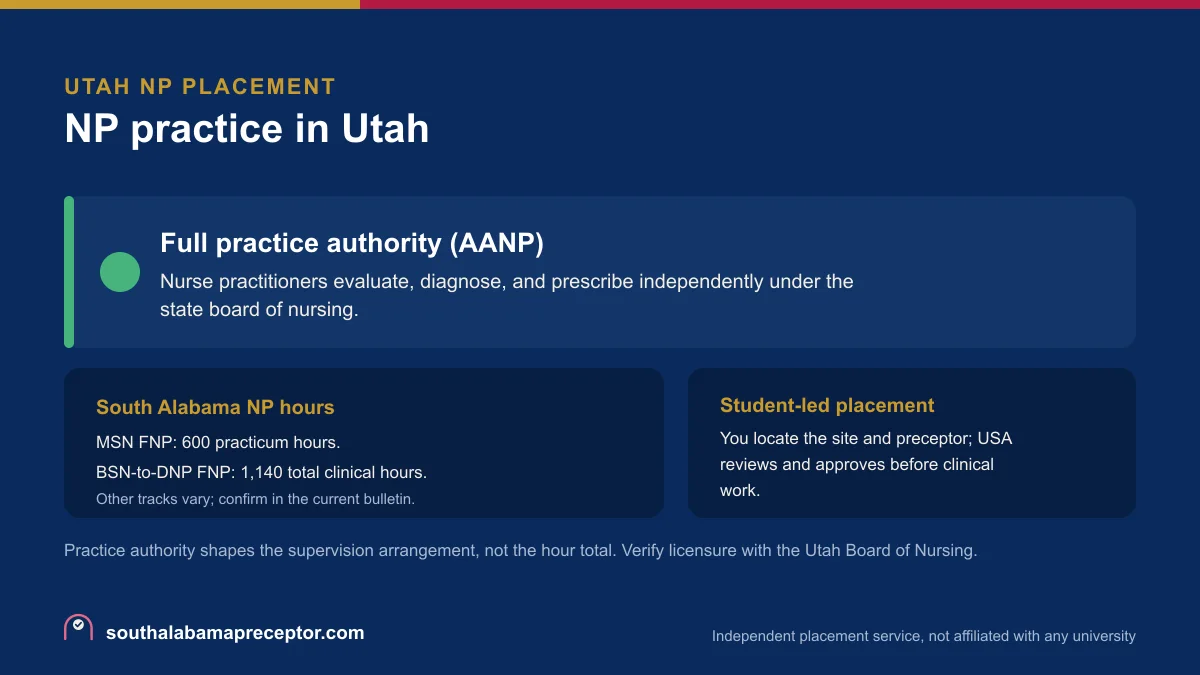
Full practice supports a broad Utah search
AANP classifies Utah as a full practice state. Nurse practitioners provide core care within licensure, certification, competence, and workplace policy without a permanent physician collaboration mandate. Independent practices, community clinics, behavioral health programs, and health systems can be considered.
Full practice does not establish course fit. The proposed clinician still needs the correct specialty, patient population, schedule, and teaching capacity. Students remain supervised under approved objectives and site policy.
South Alabama expects a preceptor licensed in the relevant specialty, approved by the university, and experienced for at least one year.
Verify Utah credentials through DOPL
Utah's Division of Professional Licensing, or DOPL, licenses nurses and APRNs and provides official verification and application guidance. Check the candidate's active credential, role, specialty or population focus, and public record.
Request a current CV and confirm patient ages, diagnoses, volume, available shifts, student history, and direct supervision. The actual setting must support the specific course.
Identify the authorized educational contact. Large systems may centralize student review, while independent practices may decide locally. Both need authority to complete site documents and onboarding.
Use Utah's north to south corridors
Salt Lake City, West Valley City, Murray, Sandy, and Draper contain the state's largest mix of primary, psychiatric, adult, women's health, and specialty care. Ogden and Layton form a northern Wasatch Front cluster, while Provo and Orem anchor Utah County.
St. George is the main southwestern hub, with Cedar City adding regional options. Logan supports Cache Valley. Price and Vernal can serve eastern searches, though smaller markets often require a wider radius.
Mountain roads and winter conditions affect travel. Give sites the track, course, dates, patient needs, weekly schedule, and expected South Alabama process.
Compare sites on patient fit, teaching capacity, and term continuity as well as distance. Ask whether the clinician can host for the full calendar, who covers absences, and which person controls student compliance. Record the exact address, specialty, patient ages, weekly volume, proposed days, and organizational contact. A complete record helps the Office for Clinical Affairs assess a real placement rather than a promising lead that lacks site permission or enough qualifying care.
Follow the student-led placement path
South Alabama students locate clinical sites and preceptors in their home region. The Office for Clinical Affairs assists with placement tasks, and South Alabama reviews and approves the proposed Utah clinician and organization before clinical work.
Placement is tied to full admission. Confirm current status, timing, course rules, and required documents before seeking a commitment. A verbal yes does not complete university or site approval.
The organization may require health records, background clearance, privacy training, learner applications, or orientation. Begin compliance and agreement work early.
Apply the correct South Alabama hour plan
The MSN FNP requires 600 hours across CMN 573, CMN 575, and CMN 576, distributed as 180, 180, and 240 hours. The BSN-to-DNP FNP totals 1,140 hours, including 600 practicum and 540 residency hours.
The dual FNP and Emergency NP MSN requires 840 clinical hours. Other tracks vary, so confirm the current handbook, course sequence, eligible settings, and patient requirements before assigning expected hours.
One Utah practice may support only part of the plan. Ask about continuity, volume, specialty exposure, and schedule stability, and begin another search when later objectives differ.
Coordinate online coursework and Mobile orientation
South Alabama delivers the coursework online, while Utah students generally complete clinical experiences in their home region. NP DNP students also attend an orientation in Mobile that typically lasts about three to five days, so confirm the current dates and format before arranging travel.
Online study does not prove Utah program or placement authorization. Confirm current South Alabama availability for the actual site and patient locations before sourcing, particularly across state lines.
We source physical placements and virtual preceptorship routes. Virtual activity depends on the course, university, site, state, patient location, and preceptor setup. Confirm accepted activity before relying on it.
Review a match before payment
Students see the proposed match before payment and pay only when a placement is secured. The fee covers sourcing, verification, and compliance coordination. Pricing is on the cost page. South Alabama and the site retain approval authority.
Provide the track, course, Utah location, travel radius, target term, schedule, patient needs, and virtual preference for accurate screening.
Share them through a free placement review. We will assess physical and virtual routes without treating the page as proof of state eligibility.
Plan Utah travel beyond the Wasatch Front
Salt Lake City, Provo, Ogden, and their surrounding communities provide the largest connected market, but traffic and clinic schedules still shape weekly feasibility. St. George, Logan, Cedar City, and rural areas can extend the search with longer travel and fewer backup clinicians. Compare the actual shift times and full-term commute before asking a practice to reserve space.
When a Utah clinician works across locations, confirm which legal site will host the student, where patients will be located, and who can authorize student access. Ask about coverage during leave, low-volume days, and weather interruptions. If the plan includes virtual activity, present the physical and remote pieces as one supervised proposal so South Alabama and the organization can review the complete schedule and documentation process.
Good to know
Is Utah a full practice state?
Yes. AANP classifies Utah as full practice, though South Alabama students remain supervised and need university and site approval.
Who finds a South Alabama preceptor?
The student locates the site and preceptor. The Office for Clinical Affairs assists, and the university approves proposals.
What experience must a preceptor have?
At least one year, plus licensure in the relevant specialty and South Alabama approval.
Can Utah clinicals include virtual care?
They may when the course, university, site, state, patient location, and preceptor setup allow the supervised activity.
Clear the gate, not your calendar
Tell us your track, your city, and your admission timeline. We will come back with a placement plan and a realistic path to full admission and your clinical hours.