How to Plan a Tennessee Preceptor Search
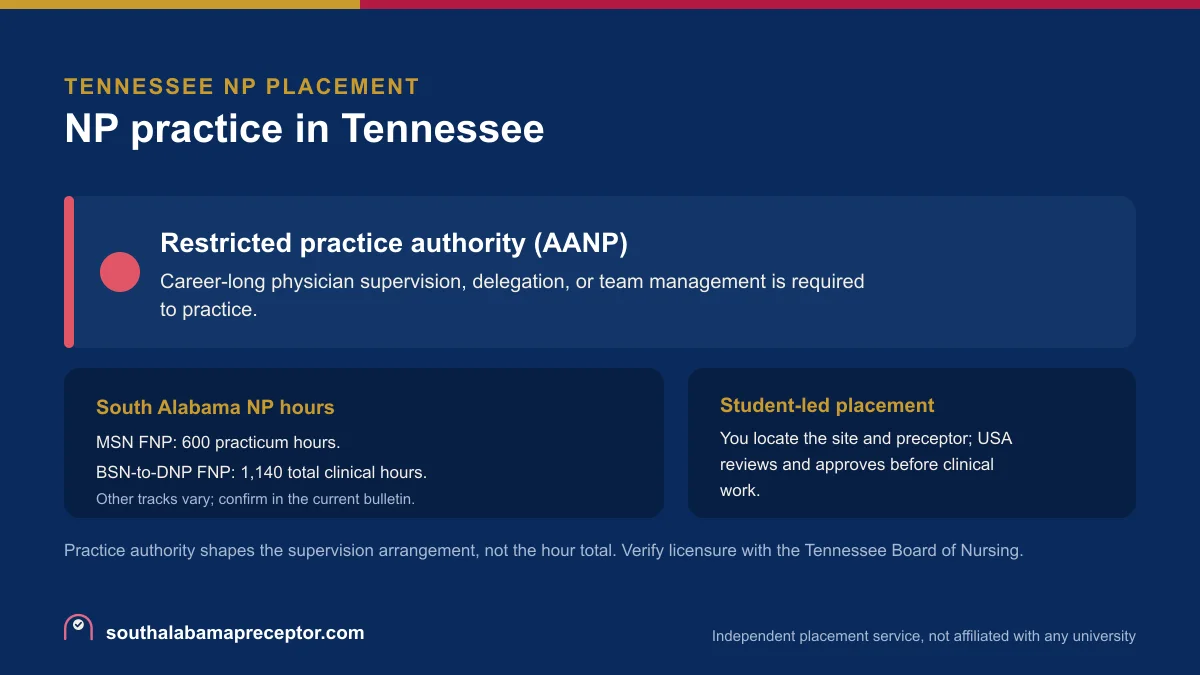
Tennessee is a restricted practice state where state requirements mandate physician involvement in at least one element of nurse practitioner practice. South Alabama students locate their own sites and preceptors, with assistance and university approval.
Tell us your USA track and city. No payment until your preceptor and site are confirmed.
Restricted practice changes candidate screening
AANP categorizes Tennessee as a restricted practice state. Nurse practitioners deliver primary, psychiatric, adult, women's health, and specialty care within Tennessee authorization and required professional relationships. Confirm how the clinician's arrangement functions at the proposed site.
Then evaluate specialty, patient access, schedule, and teaching capacity. State compliance does not establish South Alabama course fit. Students remain supervised under approved objectives and site policy.
For a Tennessee placement, the clinician needs relevant specialty licensure, at least one year of applicable experience, and South Alabama approval before supervising the student's course work.
Verify credentials through the Tennessee Board
The Tennessee Board of Nursing, within the Department of Health, licenses nurses and advanced practice nurses and provides official verification. Check the candidate's active license, APRN status, population focus, relevant prescribing information, and public record.
Request a current CV and confirm patient ages, diagnoses, volume, available shifts, student history, and direct supervision. The actual patient panel must support the intended course.
Identify the educational decision maker. Health systems may centralize student approval, while independent practices may decide locally. Both need authority to accept learners and complete documents.
Use Tennessee's separate clinical markets
Nashville has a broad mix of health systems, private practices, community care, behavioral health, women's health, and specialties. Franklin, Murfreesboro, Hendersonville, and Clarksville broaden Middle Tennessee options.
Memphis anchors the west, with Jackson providing a regional market. Knoxville is the main eastern hub, while Chattanooga has its own hospital and outpatient network. Johnson City, Kingsport, and Bristol form the Tri-Cities market.
Define travel limits around traffic and early shifts. Give sites the track, course, term, patient needs, schedule, and expected university process.
Compare practices on patient fit, weekly capacity, term continuity, and organizational readiness. A nearby office may be convenient but too narrow for the course, while a regional clinic may provide stronger exposure. Ask who covers preceptor absences, whether the site limits learner days, and which contact handles compliance documents. Keep the exact address, proposed clinician, specialty, patient population, schedule, and decision maker together for the Office for Clinical Affairs review.
Follow South Alabama's placement process
University of South Alabama placement is student-led. Students locate their own sites and preceptors. The Office for Clinical Affairs assists, and South Alabama reviews and approves the Tennessee clinician and organization before clinical work.
Placement is tied to full admission. Confirm current status, timing, course rules, and required documents before seeking a commitment. A verbal yes does not complete either approval.
The practice may require health records, background screening, privacy education, learner applications, or orientation. Begin compliance and agreement tasks early.
Match the Tennessee site to program hours
The MSN FNP requires 600 hours across CMN 573, CMN 575, and CMN 576, distributed as 180, 180, and 240 hours. The BSN-to-DNP FNP totals 1,140 hours, including 600 practicum and 540 residency hours.
The dual FNP and Emergency NP MSN requires 840 clinical hours. Other tracks vary, so confirm the current handbook, course sequence, eligible settings, and patient requirements before assigning hours.
A Tennessee site may support only one portion of the plan. Ask about continuity, patient volume, specialty exposure, and schedule stability, and begin another search when needed.
Plan home-region clinicals and Mobile orientation
Coursework is online, and clinical experiences generally occur in the student's home region. NP DNP students also attend a Mobile orientation typically lasting about three to five days. Confirm current dates and format.
Online delivery does not prove Tennessee program or placement authorization. Confirm current South Alabama availability for the actual practice and patient locations before sourcing.
We source physical placements and virtual preceptorship routes. Virtual activity depends on the course, university, site, state, patient location, and preceptor setup. Confirm accepted activity before relying on it.
Review the match before payment
Students see the match before payment and pay only when a placement is secured. The service fee covers sourcing, verification, and compliance coordination. Pricing appears on the cost page. South Alabama and the site retain approval authority.
Provide the track, course, target term, Tennessee region, travel radius, schedule, patient needs, and virtual preference for accurate screening.
Send the Tennessee details through a free placement review. We will compare course-ready physical and virtual routes while leaving current state eligibility and academic decisions with South Alabama.
Separate Tennessee provider interest from site readiness
A Tennessee clinician may be ready to teach while the employing organization still needs to decide whether it can host an outside student. Ask Nashville, Memphis, Knoxville, Chattanooga, and regional practices who controls learner access, whether the requested department has capacity, and which documents can move before a final decision. Record the practice's legal name as well as the public-facing clinic name.
Then test the proposed schedule against the course rather than accepting a general offer. Confirm patient ages, common conditions, weekly volume, clinical days, direct supervision, evaluation availability, and any specialty-specific experiences. If one element is uncertain, keep a second physical or eligible virtual route active. The backup should be screened to the same standard so it can become a real proposal rather than another unverified lead.
Good to know
Is Tennessee a restricted practice state?
Yes. AANP classifies Tennessee as restricted practice because state requirements mandate physician involvement in at least one element.
Who locates a South Alabama preceptor?
The student locates the site and preceptor. The Office for Clinical Affairs assists, and the university approves the proposal.
How many clinical hours does the MSN FNP require?
It requires 600 hours across CMN 573, 575, and 576, divided into 180, 180, and 240 hours.
Does this page prove Tennessee availability?
No. Confirm current South Alabama program and clinical availability before sourcing.
Clear the gate, not your calendar
Tell us your track, your city, and your admission timeline. We will come back with a placement plan and a realistic path to full admission and your clinical hours.