Build a USA clinical search across North Carolina
North Carolina is a restricted practice state under AANP's current framework. Major medical markets and regional communities offer University of South Alabama possibilities, while required supervision, joint regulation, student-led sourcing, and USA approval shape the plan.
Tell us your USA track and city. No payment until your preceptor and site are confirmed.
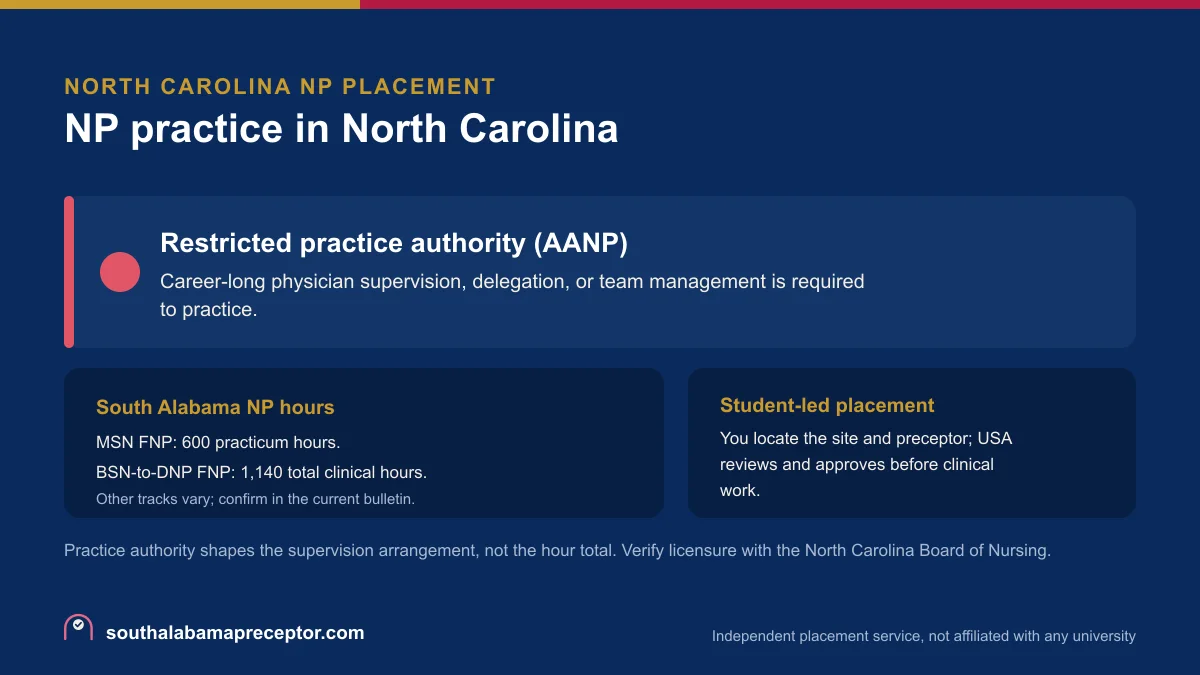
Restricted practice shapes North Carolina arrangements
AANP classifies North Carolina as a restricted practice state. Nurse practitioners are jointly regulated by the North Carolina Board of Nursing and North Carolina Medical Board and practice through a required supervising physician arrangement.
NPs assess patients, diagnose, manage treatment, order tests, prescribe, and coordinate care within that structure. Restricted practice does not necessarily mean the supervising physician attends every encounter.
Confirm current University of South Alabama program and clinical eligibility for North Carolina before sourcing. State rules do not authorize an individual placement.
Start with the North Carolina Board
The North Carolina Board of Nursing maintains an official nurse practitioner section with rules, applications, guidance, and credential resources. Search the preceptor by legal name and confirm active authority.
The clinician should be licensed in the specialty, USA approved, and have at least one year of relevant experience. Verify national certification, supervising arrangement, patients, role, address, and availability.
Use North Carolina's distinct regions
Raleigh, Durham, and Chapel Hill form the Triangle's academic, community, outpatient, psychiatric, primary care, and specialty market. Systems often require central student applications.
Charlotte has another large pool. Greensboro, Winston-Salem, and High Point support the Triad, while Asheville and Boone are western hubs. Rocky Mount and eastern communities broaden searches, and Wilmington anchors the southeast.
Describe the USA track, course, patients, dates, schedule, and preceptor details. Ask whether education, credentialing, or local management controls access.
Lead the search with Clinical Affairs assistance
USA follows a student-led process. Students locate sites and preceptors. The Office for Clinical Affairs assists, while USA reviews and approves each proposed experience.
Placement is tied to full admission. Confirm current admission and placement rules before relying on a North Carolina clinician.
Facilities may require screening, health documentation, privacy training, orientation, or department review. University and site clearance are required.
Track the site and supervising structure
Keep the clinic location, education contact, preceptor credentials, specialty license, experience, supervising arrangement, patients, dates, capacity, and open compliance tasks in one record.
Choose an alternate region and ask how supervision, leave, holidays, cancellations, and student limits affect capacity. Every backup requires USA approval.
Record the exact education or credentialing office, legal practice entity, internal deadline, response date, and next university step. Triangle and Charlotte systems may use separate departments and locations.
Confirm patient volume across the full course and document how the required supervising arrangement operates at the site. These details help distinguish state authority from the student's approved role.
Test the commute at actual shift times. Triangle, Triad, Charlotte, western, eastern, and coastal markets have different travel and provider patterns.
Keep a second region active until USA review and site onboarding are complete. The alternate still needs appropriate patients, a qualified preceptor, and supervision.
Ask how provider leave, department changes, holidays, and patient cancellations affect capacity. Build approved backup days where possible.
Clarify whether a different clinician or address requires new review. Approval for one North Carolina site should not be assumed to cover another office. Before submission, compare clinic dates with Mobile orientation travel, work commitments, course requirements, and every facility onboarding deadline. Save each approval and schedule update in the placement record.
Plan current USA hours by course and region
The USA MSN FNP requires 600 hours: 180 in CMN 573, 180 in CMN 575, and 240 in CMN 576. The BSN-to-DNP FNP totals 1,140 hours, with 600 practicum and 540 residency hours. The dual FNP and ENP MSN totals 840 hours.
Other tracks vary. Confirm the current handbook, program of study, course, and admission term. Ask about eligible volume, preceptor days, leave, holidays, commute, and supervision.
USA nursing is CCNE accredited, and the institution is accredited by SACSCOC. Keep tracking and compliance systems generic and follow current instructions.
Coordinate local clinicals and Mobile orientation
Coursework is online, with approved clinical experiences arranged in the student's home region. NP DNP students should plan for a Mobile orientation of about 3 to 5 days and confirm current requirements.
Our service offers physical placements and virtual preceptorship routes. Virtual care depends on the course, USA, site, North Carolina requirements, patient location, and preceptor setup. Confirm what will count.
Add targeted sourcing to a North Carolina search
We can source North Carolina preceptors by track, course, region, commute, dates, and patients and organize the match for review. Students see the match before payment and pay only when a placement is secured. The fee covers sourcing, verification, and compliance coordination. Terms are on the cost page. Share your plan through a free placement review.
North Carolina planning should distinguish the Triangle, Charlotte, the Triad, the coast, and western communities before outreach begins. The student should provide course dates, specialty, patient requirements, weekly availability, and a commute limit that can be maintained. If a second region is acceptable, its travel conditions should be stated clearly. That information helps us compare prospects on practical fit and prepares a more useful proposal for the Office for Clinical Affairs and USA, including the actual site, clinician role, planned schedule, and clinical activities under consideration.
Good to know
Is North Carolina a restricted practice state for NPs?
Yes. AANP currently classifies North Carolina as restricted practice. Confirm current USA program and clinical eligibility before sourcing.
Who finds a USA preceptor in North Carolina?
Students locate sites and preceptors. The Office for Clinical Affairs assists, and USA approves the arrangement.
What experience should the preceptor have?
The preceptor should be licensed in the specialty, USA approved, and have at least one year of relevant experience.
Can virtual care be included?
It may when the course, USA, site, state, patient location, and preceptor setup allow it. Confirm current requirements.
Clear the gate, not your calendar
Tell us your track, your city, and your admission timeline. We will come back with a placement plan and a realistic path to full admission and your clinical hours.